English
Water temperature for coffee: why 92–96 °C doesn't apply in Mexico City
The SCA range of 92–96 °C was written at sea level. This guide gives the boiling point and the realistic target for ten Mexican cities, plus what under- and over-heated water actually taste like.
By Jorge Aguilar · Published · Updated
Short answer
Brew between 92 and 96 °C. But above roughly 1,900 m — Mexico City, Toluca, Puebla — water boils below 93 °C, so that range is physically out of reach and the correct instruction becomes: pour the moment it boils.
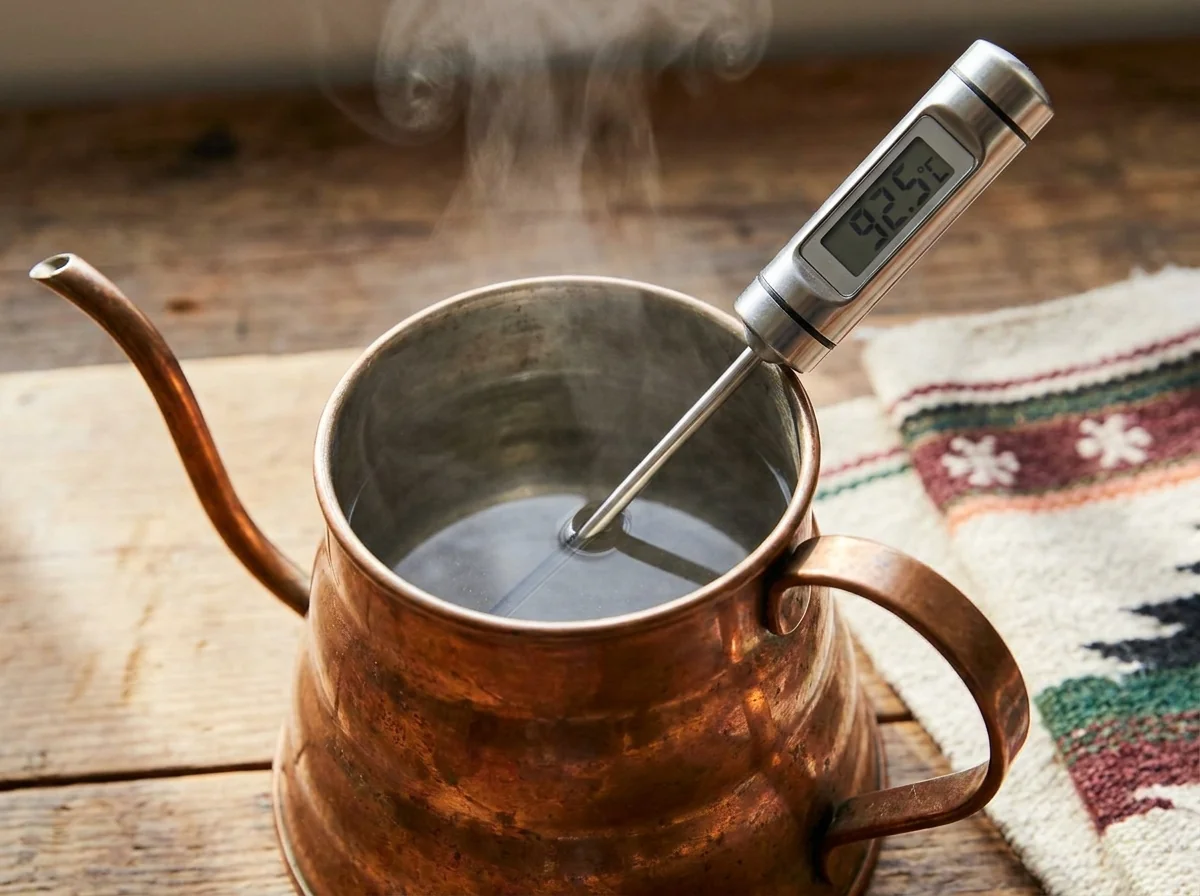
Water temperature decides how fast coffee dissolves. Too cool and the cup is sour and thin; too hot and it turns bitter and drying. The Specialty Coffee Association puts the working range at 92 to 96 °C.
That range has an assumption baked into it that almost nobody states: it was written at sea level.
The number that changes everything: your altitude
Water boils lower as you climb. At 2,240 m — Mexico City — it boils at about 92.6 °C. That is not a recommendation you can ignore; it is a ceiling. Asking for 96 °C there is asking for something your kitchen cannot produce without a pressure vessel.
| City | Altitude | Boils at | Real target |
|---|---|---|---|
| Toluca | 2,660 m | 91.2 °C | 91.2 °C — pour at the boil |
| Ciudad de México | 2,240 m | 92.6 °C | 92.6 °C — pour at the boil |
| San Cristóbal de las Casas | 2,200 m | 92.7 °C | 92.7 °C — pour at the boil |
| Puebla | 2,135 m | 92.9 °C | 92.9 °C — pour at the boil |
| Guadalajara | 1,566 m | 94.8 °C | 93 °C |
| Oaxaca de Juárez | 1,555 m | 94.8 °C | 93 °C |
| Xalapa | 1,427 m | 95.3 °C | 93 °C |
| Monterrey | 540 m | 98.2 °C | 93 °C |
| Culiacán | 55 m | 99.8 °C | 93 °C |
| Veracruz | 10 m | 100.0 °C | 93 °C |
So the instruction splits by where you live:
- Above 2,000 m — Toluca, Mexico City, Puebla, San Cristóbal. Pour the moment it breaks the boil. Every second you wait moves you further from the range, not closer.
- Between 1,000 and 2,000 m — Guadalajara, Oaxaca, Xalapa. You have some headroom: wait 15 to 20 seconds.
- Near sea level — Veracruz, Culiacán, Monterrey. Wait the full 30 to 45 seconds, or you will overshoot.
Those figures are calculated, not measured: standard atmospheric pressure at each altitude, then the Antoine equation for water. Weather moves real pressure by a few hectopascals, worth tenths of a degree. For deciding whether to wait or pour, that is plenty.
Without a thermometer
Boil the water and wait 30 to 45 seconds — at sea level. In a normal kitchen, a litre of freshly boiled water drops to around 94 °C in that time.
One more thing that costs you degrees: a cold carafe. Preheat it. Always.
What it tastes like when it's wrong
Too cool:
- Sour, salty, thin-bodied.
- Easy to confuse with a coarse grind. If you have already dialled the time and it still tastes sour, raise the temperature before touching the grinder again.
Too hot:
- Bitter, drying, hollow in the finish.
- Most common with dark roasts, which give up their soluble compounds faster.
What we don't claim
We have not measured these cups in a lab. The temperature ranges come from the SCA standard cited below; the altitude figures come from published physics. When we run the test ourselves, the date and the results go on this page.
Fuentes
- Golden Cup Standard (SCA Standard 310-2021) — Specialty Coffee Association · verificada el 16 de agosto de 2026